We’re putting together our proposal for an event in San Francisco’s Lit Crawl festival, and this year we’re asking you to submit your work for a chance to read on stage!
Lit Crawl organizers want audience participation, so we’ve come up with a format to do that and also support a wide variety of stories. At the end or in the middle of your reading, you’ll ask the audience for a simple prediction of what would work best for the story. It can be a yes-no question or limited multiple choice; it can be about plot or a character’s state of mind or the story world.
1) an expression of interest confirming your availability to read the evening of Saturday, October 24th
2) a draft (or idea) of a new or finished piece before that could be modified for this exercise
3) the draft of the question you’d ask the audience
4) a <75-word bio of yourself
Though we won’t be able to accommodate everyone, we’re looking forward to reading your work!
We should know whether we’ll be hosting a Crawl event by the end of the summer.
SFWW moderators
PS: Here’s how we’re describing it in our Lit Crawl submission:
Who hasn’t suffered a devastating split? Whether from a lover, a lifestyle, reality, or the known world, such partings are never easy (though they may be exhilarating). Regulars of the San Francisco Writers Workshop share stories of characters on the cusp of a major transition: such as breaking with a spouse, shattering a window of goodwill (or of glass), placing an irrevocable bet on a comforting illusion, or just crossing a red line.
At a suspenseful point in each story, the reader will have the audience weigh in by asking for simple input about what would be best for the story. Should the widow ignore her phone? Should the astronaut leave the capsule? Should that purring noise be coming from a space heater, a ghostly visitor, or inside Veronica’s head?
After gauging audience response, readers will share any portion of the story remaining, reflect on outcomes they’d considered, and how they just might take participants’ input onboard for revision.
This holiday season, the San Francisco Writers Workshop WILL meet on Tuesday, December 23, and WILL NOT meet on Tuesday, December 30. We will see you back at Noisebridge (272 Capp Street) on January 6, 2026.
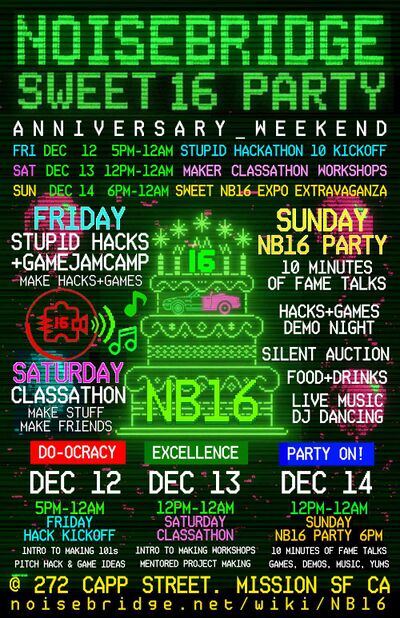
Speaking of Noisebridge, thanks in part to your efforts, their GoFundMe page has raised almost $22,000 so far. Let’s please continue donating, as much as possible, to ensure that we have a stable place to meet in 2026 and onward. Noisebridge is truly a special place. Anyone curious about it is enthusiastically invited to check out Noisebridge this weekend: all types of hackers will be celebrating NB’s 16th anniversary! Take a look at all the festivities on Noiserbridge Wiki.
To learn more about the Noisebridge community, consider joining the Discord: https://discord.gg/GtpDdX5.
Coming up this Friday night, June 6, 2025, at 7 pm. Join us in supporting NOISEBRIDGE, 272 Capp Street!
Our list of featured readers includes Tamim Ansary, who moderated our workshop for 22 years, as well as one of the current moderators, Monya Baker, and several of our stellar regulars. (Full list of bios is below.)
We will have a book raffle, a game of SFWW bingo, food, and an opportunity to tour Noisebridge. Bring your friends and help us spread the word!
Boasting a woodworking space, electronics, sewing, and music rooms, 3D printing and laser cutting equipment, and meetups on everything from philosophy and writing to game design, math, physics, and AI, NOISEBRIDGE is a bustling community. They strive for excellence among their membership as well as consensus on all of their decisions. They are a “do-ocracy,” encouraging members to get engaged on all aspects of running a collaborative space. None of this is easy to achieve, and it’s been inspiring to see this community work through issues that arise.
Tamim Ansary was born in Kabul, Afghanistan, and came to the United States as a junior in high school. His new book, Truther Narratives, looks at conspiracy theory as a special case of a larger issue: the role that narrative plays in shaping social reality. Ansary is the author of The Invention of Yesterday that looks at world history as the story of ever-increasing human interconnectedness, Destiny Disrupted, a history of the world through Islamic eyes, Games without Rules, a history of Afghanistan from an insider’s point of view, West of Kabul, East of New York, a literary memoir about straddling a cultural fault line in the world (Islam and the West), The Widow’s Husband, a historical novel set against the background of the First Anglo-Afghan war, and some 30 nonfiction books for children. In Road Trips, he tells the story of morphing from an Afghan into an American just as the sixties were giving way to the seventies. Ansary’s work has won the Northern California Book Award for nonfiction and was selected as a One City One Book pick by both San Francisco and Waco, Texas. In 2001, an email he sent to 20 friends reputedly became the first viral phenomenon of the Internet Age, reaching tens of millions around the world within days. Ansary directed the San Francisco Writers Workshop for 22 years.
Monya Baker spent close to a decade as a senior editor with Nature magazine. Her reported articles have appeared in the Economist, New Scientist, Slate, Wired, and elsewhere. She has published fiction with Nature Futures and Flash Fiction Magazine. Her novel-in-progress, That They Might Have Joy, placed first in the Mendocino County Writers’ Conference Contest. She is a co-moderator at the San Francisco Writers Workshop.
Lilian Delcid is a local writer born in Maryland and raised in the Mission. She specializes in obsessing over and torturing the people in her head who, strangely, always have the same problems she does. Her inspirations include Matthew McIntosh, Emma Donoghue, and Sidney Gish.
Brian Hurley is the Publishing Director at Sasquatch Books, an independent publisher distributed by Penguin Random House. He has been an editor at Oxford University Press, The Rumpus, and a data-driven startup that was acquired by PRH. Books he edited have been Amazon and Wall Street Journal bestsellers, and have sold over 500,000 copies. Authors he has worked with have won the Pulitzer Prize and been named one of Time’s 100 most influential people. He founded a small press called Fiction Advocate devoted to innovative literary criticism. He was named a Rising Star by Publishers Weekly in 2024. A native San Franciscan, he is working on a novel.
Zero Ramos Laforga is a Filipino queer trans poet, photographer, musician, and educator based in San Francisco. His poetry has previously been published in Ignatian Literary Magazine, The Quarter(ly) Journal, Here: a poetry journal, and most recently The Ana.
Jasper Lydon is a researcher and writer on America’s alternative communities, from anarchist compounds in New Mexico to urban farmer collectives in Detroit. Their work has been featured in HuffPost and Communities Magazine. More notably, they have shucked over 2,000 different types of okra.
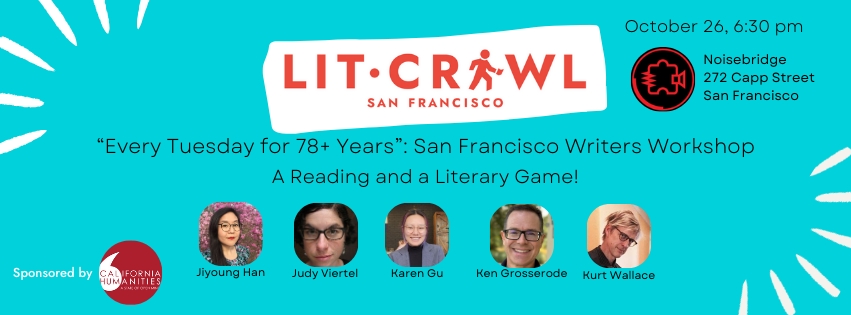
We hope to see many of you at Noisebridge this Saturday for our reading at Lit Crawl. This year, this pub crawl of literary readings will feature 60 events in one night all across San Francisco’s Mission neighborhood, and we’re honored to be a part of it. For more on Lit Crawl, check out this article on Mission Local. Here’s more info on our event:
When: Saturday, October 26, 6:30 – 7:30 pm
Where: Noisebridge, 272 Capp Street, San Francisco
What: A reading and a participatory literary game!
Writers bios:
Ken Grosserode is an attorney and writer in San Francisco. He lives with his partner in what was once a nunnery. His influences include Iris Murdoch, Donna Tarrt, and the ghosts of various Catholic nuns.
Karen Gu is a software engineer and writer based in the San Francisco Bay Area. Her work explores power, identity and feminism through science fiction, fantasy, and friends.
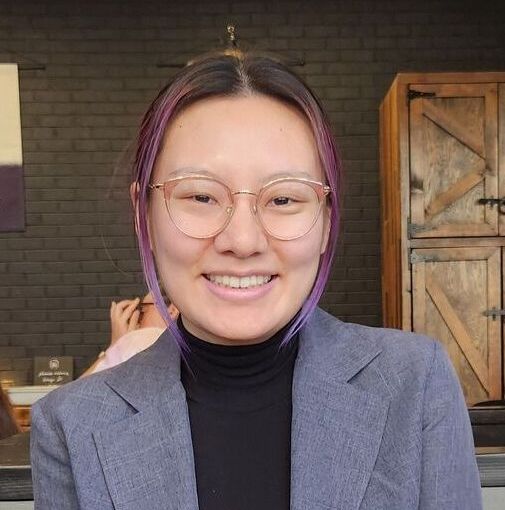
Jiyoung Han is a writer from Seoul, South Korea. She daylights as a sustainability researcher looking to make carbon reduction easier for everyone. Her writing often uses fantastical elements to examine the impacts of colonialism on people’s day-to-day lives.
Kurt is a fiction writer, focused on strange tales of idiocy and culture, inspired by Northern California.
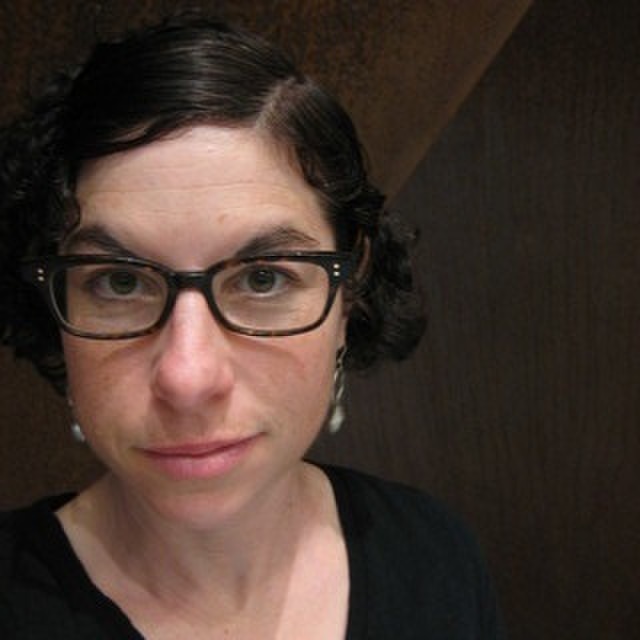
Judy Viertel has been published in Gargoyle Magazine, Gold Dust Magazine, Identity Theory, and Short Story America: Anthology Five. She’s one of four moderators for that venerable but ornery West Coast institution, the San Francisco Writers Workshop. If you were wondering if she can dance the shim sham, the answer is yes. She certainly can.
Dear writers, on Saturday, August 3rd, our venue, Noisebridge Hackerspace, is having a party and a fundraising drive. It has been such a vibrant place to meet for us. Let’s come out to support them!
For this Saturday starting at 7pm, they’re planning a wild 15th year anniversary party:
* Music and dancing with dance lessons! (Krunking, Judy thinks) * Food and Beverages! * Rube Goldberg hackathon award ceremony! * Noisebridge Shark Tank!/Pitch Competition * Sidewalk astronomy! (weather permitting) * Raffle, silent auction, and swag sale! * Member activity showcases!
If you’ve been curious about this place, this is the perfect time to check it out. It’s a fundraiser, but no one will be turned away for lack of funds. Our own Judy Viertel is certainly planning on being there.
Dear San Francisco Writers Workshop community — join us this Friday, May 31, at 7 pm for a reading and fundraiser for our venue.
The event will take place at Noisebridge, 272 Capp Street. We will have featured readers, a raffle, food and drink, a storytelling game, an opportunity to tour Noisebridge, and lots of fun!
Suggested donation starts at $10, and please give as much as you can.
Colleen Shoshana McKeeis the author of six books of poetry, fiction, and memoir. Her latest collection is Routine Bloodwork, a finalist for the Charlotte Mew Award from Headmistress Press.
Divyanka Sharma is a tech strategist, fiction writer, poet, and documentary filmmaker. Her creative pieces have been published online and in print, including with Empyrean, the other side of hope, The Wire.in, among others. Her writing explores the immigrant experience of movement and adaptation and her work is informed by her birth country of India and adopted home in the United States.
Howard Isaac Williams‘ essays, remembrances, reviews, poetry and fiction about culture, Nature, messenger lore, Afghanistan and other topics have been published in The Atlantic (online), Philosophy Now and over 20 other venues. His unpublished novel The Chastisement is the only book about Chinghis Khan researched in both Mongolia and Afghanistan.
L.M. Pino is a queer Mexican writer living in the Bay Area. Her latest short story, The Woman Without Skin, is forthcoming in Ignatian Literary Magazine.
Nina Rodenko is a winner of the 2022 Clark-Gross Scholarship Award for her debut novel, United Selves of Veronica, which is currently in its final draft. Her fiction and nonfiction have appeared in Bookstr, Prometheus Dreaming, and Watershed Review. Born in Ukraine, Nina lives in San Francisco.
Olga Zilberbourg’s English-language debut LIKE WATER AND OTHER STORIES (WTAW Press) explores “bicultural identity hilariously, poignantly,” according to The Moscow Times. She serves as one of the co-moderators of the San Francisco Writers Workshop.
San Francisco Writers Workshop is hosting our annual benefit to support the venue that has been so generously providing us with a space to meet for the past two years: Noisebridge, a legendary anarchist hackerspace in the San Francisco’s Mission district. Noisebridge doesn’t charge writers to gather every Tuesday night, but they certainly have a large rent bill to pay. This is our chance to help ensure their and our own future!
Boasting a woodworking space, electronics, sewing, and music rooms, 3D printing and laser cutting equipment, and meetups on everything from philosophy and writing to game design, math, physics, and AI, Noisebridge is a vibrant and bustling community. They strive for excellence among their membership as well as consensus on all of their decisions. They are a “do-ocracy,” encouraging members to get engaged on all aspects of running a collaborative space. None of this is easy to achieve, and it’s been inspiring to see this community work through issues that arise.
The event will include featured readers, a storytelling game, food and non-alcoholic drinks, and an opportunity to tour Noisebridge. PLEASE HELP US SPREAD THE WORD!
Mark your calendars for 7 pm on May 31, 2024, at Noisebridge, 272 Capp Street. Suggested donation starts at $10, and please give as much as you can!
Colleen Shoshana McKeeis the author of six books of poetry, fiction, and memoir. Her latest collection is Routine Bloodwork, a finalist for the Charlotte Mew Award from Headmistress Press.
Divyanka Sharma is a tech strategist, fiction writer, poet, and documentary filmmaker. Her creative pieces have been published online and in print, including with Empyrean, the other side of hope, The Wire.in, among others. Her writing explores the immigrant experience of movement and adaptation and her work is informed by her birth country of India and adopted home in the United States.
Howard Isaac Williams‘ essays, remembrances, reviews, poetry and fiction about culture, Nature, messenger lore, Afghanistan and other topics have been published in The Atlantic (online), Philosophy Now and over 20 other venues. His unpublished novel The Chastisement is the only book about Chinghis Khan researched in both Mongolia and Afghanistan.
L.M. Pino is a queer Mexican writer living in the Bay Area. Her latest short story, The Woman Without Skin, is forthcoming in Ignatian Literary Magazine.
Nina Rodenko is a winner of the 2022 Clark-Gross Scholarship Award for her debut novel, United Selves of Veronica, which is currently in its final draft. Her fiction and nonfiction have appeared in Bookstr, Prometheus Dreaming, and Watershed Review. Born in Ukraine, Nina lives in San Francisco.
Olga Zilberbourg’s English-language debut LIKE WATER AND OTHER STORIES (WTAW Press) explores “bicultural identity hilariously, poignantly,” according to The Moscow Times. She serves as one of the co-moderators of the San Francisco Writers Workshop.
Crossing Civic Plaza every Tuesday evening— a figure tall with hooked coat, his gait pivotal, a book bag slung shoulder high accenting the triangular outline, the bag clinking faintly; within, the books and papers and empty tuna cans. His voice, in parallel discongruity, rumbling kindness through his layers of awesome monumentality. He was a walking cave glimmering sound.
—Elinor Randall (aka Randy)
Every Tuesday evening, just before 7 p.m., Dean Lipton would lumber into the first floor Lurie Room in the old Main Library with his City Lights shoulder bag filled with a clatter of old tuna fish cans, which he would pass out as ashtrays to all the smokers. (Yes, you could smoke in the library in those days.) Just inside the front door, each of us would be greeted by kindly old Rusty Evans, a playwright—always wearing his signature canvas fishing hat—ever-present with his yellow legal pad, collecting names and addresses of every writer who walked in. This tradition began because Dean had seen more than one cherished writer suddenly disappear, with no way to find out if they were okay or what became of them or their work, and he didn’t want that to ever happen again.
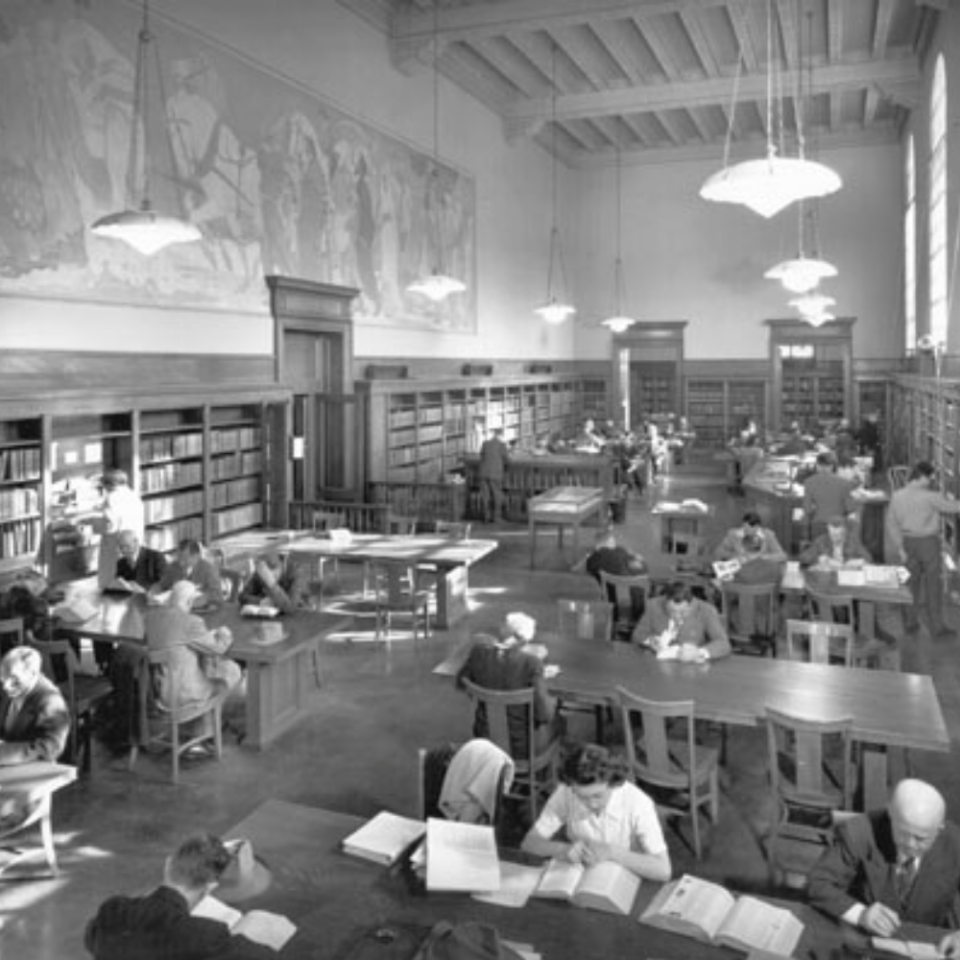
Old Main Reading Room, SFPL archive
Dean would sit at a table up front as if on stage, with a reader’s chair pulled up beside him, while we, the “audience,” sat in straight rows arranged like theatre seats. This is in contrast to later moderators’ preference for having a circle of chairs. Dean would call us up one by one to sit next to him and read our work. Sometimes he would look over the pages as the reader set them aside. (There were no shared copies back in the days of typewriters, so he was the only one who got a look at the printed words. Everyone else just listened.) Always he would have one of his Pall Mall straights burning. He was often seen with his elbow resting on the table, his chin propped on his upturned palm, his cigarette dangling between his fingers, the smoke curling up beside his head, a rapt attention on his face, the ash on his cigarette growing longer and longer and longer, until he would finally go to flick it, and the ash would invariably fall off on the table before he made it to the tuna can ashtray. After the reader finished, he’d ask in his big, gruff, cave of a voice, “Okay, what are the comments?” and a lively discussion would ensue.
No one can properly envision the Workshop during Dean’s reign without recalling Dean’s astonishing appearance. He was a towering hulk of a man with a terrible sagging wound on the whole right side of his face. Once handsome, he had been mutilated by the slip of a surgeon’s knife, which severed a facial nerve, leaving his eye, his cheek and the right side of his mouth paralyzed. His lower eyelid hung down and teared constantly. His sagging cheek puffed out with air as he spoke, making his speech often difficult to understand, and this was after several corrective surgeries. As writer Daniel Borgstrom so bluntly put it: “Dean looked like a wax figure that was left too close to an open flame.”
In addition to his appearance, Dean was known for his growling, blunt and dictatorial manner, which kept in check the boisterous ego of many an opinionated writer. Yet he could be most kind and candidly supportive, bursting forth with a shower of praise for writers whose work showed promise. He had an almost boyish enthusiasm, and more than one generation of writers gratefully benefitted from his irascible guidance. In his own writing, Dean championed underdog causes, a spirit that came in no small part from being a (very secular) Jew who had lived through the Second World War.
Some complained that Dean had no manners, but it was more like he was unaware that manners existed. Truth-seeking mattered more than any of that. He followed his own whims, letting certain comments be made while cutting others short in an often-autocratic way. Yet there was a method to his growls and barks. For one thing, he had no tolerance for pretentiousness, literary or otherwise, and he would quickly put a stop to any bombast. If he was excited about a writer’s work, he might exclaim something like, “You could be the next Jack London!” Or he could be painfully honest if he felt the need, barking things like, “Your characters are flat. If you don’t learn to make them real, you’ll never be a writer.” He also used his gruffness to protect writers from abusive comments, rudely yelling things like, “Shuddup! You don’t know what you’re talking about,” to stop others from being rude. He understood the devastating impact overly-harsh criticism could have and admonished us to use care because, “That writer might go home and not write another word for six months!” I had the feeling he was speaking from experience, both as the critic and the critiqued.
Dean’s greatest passion was understanding the creative mind and human genius at work. (In 1970, he published a book called Faces of Crime and Genius, telling the remarkable stories of several nefarious geniuses from history.) He fervently believed in each writer’s own creative spark, encouraging each unique, individual voice. He detested formulaic writing. “Writers should grow like weeds,” he would say, and he cut short comments that seemed to him like too much “pruning.” He would likely not be happy to see today’s ubiquity of MFA programs and graduates.
Back then the group was peppered with lots of Depression-era leftists, Beat and hippie poets, and union organizer types, who gave the Workshop an anti-establishment, fight-for-the-little-guy undercurrent, very much in line with Dean’s own sentiments. On the whole, we could be a scruffy lot, Dean included.
A doctor named Phil (no, not that Dr. Phil) touched into those underdog sentiments when he read his travelogues that depicted ritzy, lavish globe-trotting. A wave of objections arose from those who disapproved of the way Phil reveled in his opulent lifestyle. Dean cut their protests short, reminding us, “We’re here to discuss what the man wrote, not how he lives. If I were to travel, I’d sleep under a bridge,” said Dean, “but that’s beside the point.” Later Phil read a draft of an article lamenting the plight of physicians who were being sued for malpractice by greedy scam artists. Who knows how Dean, who had sued his own doctor for malpractice, felt about that. He gave only his usual detailed, technical critique of the author’s craft. With so many ragtag writers attending the group back then, you could tell that Dean relished the prestige and validation of having a doctor-writer in our midst, so he gave Phil plenty of latitude.
Dean was a stickler for factual and historic accuracy, both in his own writing and in the writing of others. He would tolerate long discussions if it was a matter of getting the facts straight. He especially relished the chance to parade his own considerable knowledge when a writer touched upon a subject he had studied deeply, especially if the subject was Native Americans, the nature of genius, the American frontier, or the literary history of San Francisco. In his own writing, he liked to weave factual tales with many intricate twists and turns revealed one by one, point by point, highlighting the range of opinions on the subject, then revealing his own finely-wrought conclusion.
He was most comfortable commenting on prose, and non-fiction was his forté. He would facilitate the group’s response to poetry but would comment on poems only sparingly. “Poetry is hard to criticize,” he would say, giving a wide berth for the inner process of the individual poet. One young regular, Andrew Wells, who attended in the late ‘70s and early ‘80s, read poems full of incomprehensible yet compelling images. For example:
Sight owed to the windows, even blue; machines look askance from the Conquistadors of Beef who look askance at each other…
One night after the group had engaged in a lengthy discussion of the possible meaning of one of Andy’s poems, Dean burst forth, “Andy, you’re either a total genius or you’re full of bull. We can’t understand it well enough to tell.”
Dean’s own creative process was seriously derailed by his ill-fated surgery, and he could barely write for years afterward. In his 1978 book, Malpractice: Autobiography of a Victim, Dean describes the Writers Workshop as his lifeline, keeping him in touch with people, with writing, and with the creative process. When so many aspects of his life had been turned upside down, Dean’s role as moderator gave him an ongoing stature and sense of dignity, which might otherwise have been lost. Workshop-veteran Leonard Irving described Dean as “a frustrated swashbuckler who wanted to be a war hero or Jim Bowie or a desperado, saddled and bridled and riding into the sunset, but he never got within five feet of a horse, and his dashing looks were robbed from him so suddenly.”
Dean stayed up late every night, most often hanging out in North Beach cafes and bars, wrangling with the likes of Kirby Doyle, Howard Hart, Tisa Walden, Neeli Cherkovski and Jack Hirschman. His sleep was nightmarish, he told me, flashing him back again and again to the trauma of his surgery and its aftermath. So he tired himself out by wandering the nighttime streets until the wee hours, finally making his way back to his Cabrillo Street apartment, often just before dawn. If he gave you his phone number, he was sure to say, “Don’t call before 1:00!”
Before life dealt him that fateful blow, Dean Lipton had always been a man who threw himself up against the world, who came out punching before the debate had even begun. Born to a Jewish family in Detroit in 1917, he left home at age fourteen during the Great Depression, traveling the country in boxcars, working menial jobs, living in hobo jungles and migrant camps, then working for various newspapers. He moved to San Francisco in the 1930s and got involved in various leftist groups. Over time he put himself through college, was publicist for various political campaigns, was editor of a Jewish newspaper for a few years, and published numerous articles and books, including a novel. He was also a proud father and grandfather.
Dean was an original thinker who fought for what he believed in. His own writing championed causes about which he felt passionately, and his quest for justice was never roped in by current political fashion. Most notably, his writings on the case of Toguri D’Aquino, the so-called Tokyo Rose, were the first to point out the injustice done to her, and helped eventually to win a pardon for her from President Gerald Ford in the 1970s. Dean wasn’t graceful about agreements and disagreements, but he was exceedingly straightforward in a way that made him someone you knew you could trust.
Though many were understandably ruffled by Dean’s manner, Workshop writers on the whole had an unspoken tenderness for crusty old Dean. Here he was, a giant of a man with an unmistakably scarred face he couldn’t hide, staying in the public eye, holding his head up high, and even commanding respect. His awkward dignity announced that it’s possible to carry on no matter what, an inspiration to others who themselves might have felt damaged or different and felt more of a sense of ease and belonging in the Workshop because of Dean’s lumbering composure under such obvious hardship.
By the late-1980s, more and more people were living on the streets around the library in the Civic Center and the nearby Tenderloin. The Writers Workshop had always had its share of self-professed misfits, but now it began attracting more marginal folks. This included some very talented homeless poets, who always had to worry about their manuscripts being thrown in a dumpster when they were rousted out of wherever they were sleeping. It was no surprise to see Dean being sympathetic and protective of these writers.
When steep budget cuts hit the library in 1988 and the library’s evening hours were cut, there was steep competition for meeting room space, so after more than forty years, the Writers Workshop was summarily given the heave-ho and became homeless. By then I had been working for nine years at the Main Library myself. Knowing the administrators and hearing scuttlebutt from the security guards, I could see that management was relieved to have a legitimate excuse to boot the Workshop out. Dean and the group had gotten too funky for them.
Rescued by State Senator Milton Marks, the Workshop was soon given space in the nearby State Building for several years. Now to attend the group, you had to go through a security checkpoint to get to a small, florescent-lit, windowless conference room, which was not exactly inviting but was considerably better than having no meeting space at all. Without the gravitas of being housed at the library, there were no curious drop-ins. Since the Workshop had never advertised itself, word-of-mouth became the only way to attract new writers, and the group became more insular.
On top of all that, Dean was in his seventies by then, and his stamina was waning. It was not uncommon for him to doze off while someone was reading and to be heard softly snoring. Then he would wake up with a start, embarrassing everyone but himself, and carry on as if he had been paying attention all along. That was in the last few years before he died. Scottish poet and storyteller Leonard Irving was always there as backup whenever needed, and then stepped in to lead the group when Dean died in 1992.
Dean’s funeral gathering was as unlikely and unique as he was. It was held at a surprisingly-posh funeral home on Sutter Street, not far from the library. Writers who had attended through various decades of the Workshop showed up en masse to honor him, gathering around the coffin to see his blessedly-relaxed face, his always-unruly hair pasted down in a way he never would have worn it. Then we were ushered in for the service.
Dean may rank as the most unreligious person I have ever known, a man who was deeply suspicious of “true believers” of all stripes. His two daughters, on the other hand, were Mormons, in from Salt Lake. They had invited a local Mormon minister to lead the service, along with a small choir composed of cherubic-looking young men who had just returned from various missionary stints. Then there was our group of funky, unkempt North Beach and Tenderloin poet types interspersed with clean-cut Mormons and suited morticians.
Thankfully, the Mormon minister grasped the irony of the situation—that here he was, leading a Christian service for a Jewish guy who didn’t believe there’s a god, and doing it in front of a bunch of irreverent San Francisco literati. To his credit, he pulled it off brilliantly, saying, “I understand Solomon Dean Lipton was not one to suffer fools gladly, so I had better keep my comments brief and sit down.”
The floor opened to a tremendous creative outpouring of poems and remembrances. An old college friend from the 1930s recounted how the two of them used to wrangle non-stop all night and day, roping in whoever else they could into the debate. “And remember, he wasJewish!” she said. Gail Kaplan put it all together, saying, “Dean was the real thing in a world that too often isn’t. What you saw was what you got, like it or not. And I did. I liked his growling attitude toward life. I suspect it’s what kept him alive, kept him busy fighting a world that had been most unkind to him.”
One of Dean’s daughters got up and spoke to her dead father, pleading, “Please, Daddy. Please accept Jesus Christ into your heart so we can all be together in the afterlife.” There was awkward silence while everyone imagined Dean’s grumpy response, most likely his signature, “Oh great.” I felt sorry that her Mormon beliefs were making her loss feel even bigger at such a tender time.
Leonard compared Dean to a ship: “Not one of your sleek cabin cruisers but some gaunt ragged schooner that after braving the elements still scorns safe harbor and rests restlessly, ever ready to set sail again to unknown places.” I read a poem about Dean’s restless, wakeful, all-night walks, now finally ending in his last and deepest sleep… his body soon to rest in a Mormon cemetery out in the salt flats! Culture clash and all, this disparate commemoration added up to a most worthy send-off for inimitable Dean.
On the one-year anniversary of his death in 1993, writers gathered again to commemorate him with an even greater outpouring of poems and tales. Afterward, Leonard gathered the various elegies from far-flung Workshop writers, and I edited them into a chapbook, The Dean Lipton Memorial Anthology, published by Grow Like Weeds Press, founded in Dean’s honor.
Leonard ran the Writers Workshop at the State Building for two years after that. His style was very lowkey compared to Dean’s. He didn’t hold himself out as the expert or the last word but simply facilitated the readings and comments. When his partner Randy (aka Elinor Randall) moved back east to Vermont, he began spending summers there with her. It was time to turn the leadership of the workshop over to other reliable hands.
A young Afghan-American man had been coming to the Workshop since the mid-1980s and kept showing up through its ups and downs. I remember Tamim Ansary reading a wide range of works, starting with his translations of the poet Hafez, who I had never heard of until then, and his translations of his own father’s poetry from Farsi. He was hatching an intriguing novel, set in old-world Afghanistan before the Soviet invasion. What a blessing that Tamim stepped in to lead the San Francisco Writer’s Workshop, then moderated it masterfully for 22 years after.
This piece came out of my long participation in the San Francisco Writers Workshop and from interviews I did with several old-timers. It came equally from my lifelong friendship with Leonard Irving, Randy (Elinor Randall), and Daniel Borgstrom. We spent countless hours together around the hearth at their farmhouse, sharing Workshop memories. I can hardly tell anymore which of these words came from them and which came from me.
The San Francisco Writers Workshop has a long history, so long in fact, that even its oldest living members don’t know exactly when it was founded or who the original moderator was. As close as anyone can figure, it started in 1946 or ‘47 at San Francisco’s Main Library, and has met nearly every Tuesday night since then.
No one has ever disputed the group’s claim to be the longest consecutively-running writing workshop in the country, perhaps even the world. The Workshop has witnessed the rise and fall of the Beat era, the Summer of Love, the assassination of George Moscone and Harvey Milk, the ’89 quake, the advent of personal computers and the web (with the concomitant demise of the typewriter), multiple wars, and two pandemics. It survived a sudden eviction from the Main Library in 1988 and a long nomadic period, meeting everywhere from the Civic Center Burger King to the State Building to noisy cafes to the Rex Hotel, then landing for years at Meridian Gallery near Union Square. In more recent times the group met at Alley Cat Books in the Mission District, on Zoom during COVID, and currently meets at Noisebridge, a collaborative space whose guiding rule is: “Be excellent to each other.” Each Tuesday evening at 7 p.m., yet another generation of writers continues to unfold their sheaves of paper, bringing to life their images, ideas, lyrics and tales for other participants who offer their feedback. No hype. No gimmicks. Just pure, live, original writing and critique.
I first came to the group in my early twenties in 1977, about a month after moving to San Francisco from the DC area. I attended regularly for several years, then drifted in and out of the group again and again, through various eras and incarnations. Now in 2024, it’s been there for me for 47 years, and more importantly, it’s been there for many thousands of writers for more than three quarters of a century.
So why has this workshop lasted so long? What has gone so right? First and foremost, we have to credit the devotion, generosity and constancy of its moderators who have shown up every Tuesday night for over 75 years and led the group… for free! And when it was time to retire, each moderator made sure there was someone to succeed them when they left.
The name of the original moderator has unfortunately been lost in the mists of time. By the time I started in 1977, the oldest participants didn’t know the name anymore, though some had heard that the Workshop was founded by two women. A former moderator told me that a woman named Lois Neville ran the group next, from some unknown date until 1960. Then there was the 32-year tenure of hard-boiled newspaperman Dean Lipton from 1960 until shortly before his death in 1992, followed by a two-year stint from 1992 to 1994 by Scottish poet and raconteur, Leonard Irving, who had long been backup moderator on the rare occasions when Dean couldn’t be there. Acclaimed Afghan-American writer Tamim Ansary was next, leading the Workshop for 22 years from 1994 until 2015. Tamim waited a long time for a likely successor to emerge, then struck upon the innovative solution of having a group of four seasoned participants share the role. The current team of moderators is Kurt Martin, Judy Viertel, Olga Zilberbourg and Monya Baker.
Another reason for the longevity of the San Francisco Writers Workshop is—it’s in San Francisco!—a town known for creative thinking, a counter-culture mecca, a magnet and fertile ground for writing legends like Bret Harte, Dashiell Hammett, Diane di Prima, Lawrence Ferlinghetti, Allen Ginsberg, Armistead Maupin and Alice Walker. People have long come to San Francisco looking for that special free-spirited something, and they find each other.
The set-up of the Workshop has always made it easy and inviting. You can’t beat the price—totally free—and there are absolutely no strings attached. You can come and go as often or as little as you please, as I have done for decades. There are no fund drives, publicity campaigns or membership dues. As Dean Lipton liked to say, “The Workshop doesn’t have members. It has participants.” As such, the group thrives under the power of its own persistent magnetism. For many years now, it has steadily drawn an overflow crowd.
The Workshop has always managed to keep a singular focus on its simple yet powerful mission, and has never gotten sidetracked by glamorizing itself or boasting about its accomplishments. Simply put, the group is humble. Little has been written about the Workshop over the years. The group has simply gone about its business, far below the radar of fashion or trend (though people do get excited to hear that Afghan-American writer Khaled Hossieni, author of the acclaimed novel, Kite Runner, honed his craft here). Any showcasing of its writers has been motivated not by fame or fortune but has most often been done to raise funds for the venues that have so generously donated space for the group to meet.
The Workshop has lasted, too, because it casts a wide net. It has always been open to every kind of writer and writing, welcoming all forms, genres and content—novels, poetry, essays, memoir, short stories, articles, children’s books, plays, biographies, potboilers, porn, travelogues, confessional writings, works published and unpublishable, odes and rants. If you can name it, it’s been read there.
The Workshop has also welcomed every kind of writer—locals and newly arrived writers, wealthy and poor, beginning writers and professionals, college graduates and grade school dropouts, veterans, immigrants, doctors, ex-cons, stockbrokers, exotic dancers, engineers, longshoremen, SSI recipients, techies, students, unhoused people. The lively and ever-changing mix has given generations of writers a safe view into the minds and hearts of others very different from themselves, each allowing themselves to be seen and shaped by these connections across difference.
The deepest of lifetime friendships, romances, and even marriages were forged in the group. (Frank and Hilda Kidder, for example, met at the Workshop—she was a fine arts painter and he was the local “godfather of stand-up comedy,” founding the renowned San Francisco International Comedy Competition.) Over time, these individual connections have woven themselves again and again into the fabric of real community.
As for me, I met three of my own most beloved, lifetime friends at the Workshop, and they each shaped the trajectory of my writing and my life in phenomenal and fundamental ways. They were all considerably older than I, so they are all gone now, but I recorded their memories of the Workshop, as well as interviewing a dozen or so other old-timers. Over the years, people started giving me things related to the Workshop—letters, posters, books, and other artifacts—so I initiated an SFWW archive in the San Francisco History Room at the new Main Library, donating most of what I was given. The stories I have to tell about the Workshop come from what I witnessed and what so many others confided.










 San Francisco Writers Workshop